Suppose you’re unexpectedly referred to as into your boss’s workplace sooner or later and given the robust information that you just’re getting laid off. Panic units in as you concentrate on payments, hire and placing meals on the desk.
It’s a state of affairs that many people concern. Occasions akin to job loss, medical emergencies and automobile repairs and extra can occur to anybody, with out warning or time to organize. However there’s one hack that can provide you some peace of thoughts prematurely of those occasions: An emergency fund.
An emergency fund isn’t nearly cash — it’s about not having to fret continuously about doable setbacks, figuring out you may have a security web to catch you in the event you stumble. But, in line with Bankrate’s most up-to-date emergency fund report, solely 44 p.c of People may afford to cowl an expense of $1,000 or extra from their financial savings.
If you end up uncomfortable together with your emergency financial savings or missing an emergency fund altogether, right here’s how one can construct one and stave off monetary worries.
What’s an emergency fund?
An emergency fund is cash in a checking account that’s put aside for unplanned bills, akin to medical payments, automobile repairs or dwelling repairs. An emergency fund can even make it easier to climate a lack of earnings from job loss or prolonged sickness.
Serving as a monetary cushion, an emergency fund helps you breathe simpler, figuring out you possibly can deal with life’s curveballs with out going below. It additionally reduces the necessity to depend on high-interest bank cards or expensive private loans to pay for sudden bills.
Emergency fund statistics
Bankrate not too long ago surveyed People concerning the state of their emergency financial savings, and located:
- If hit with an unplanned $1,000 expense, 44 p.c of individuals would pay it with their financial savings, in contrast with 21 p.c who would pay with a bank card, 16 p.c who would pay it however have to chop different spending, 10 p.c who would borrow from household or buddies and 4 p.c who would take a private mortgage, as of December 2023.
- Whereas a majority (55 p.c) of adults have extra financial savings than bank card debt, a big quantity (36 p.c) nonetheless have extra bank card debt, as of December 2023.
- Almost a 3rd (30 p.c) of adults have extra emergency financial savings than they did a 12 months in the past, however 32 p.c have lower than they did final 12 months and 9 p.c have none in any respect, as of December 2023.
- Greater than half (53 p.c) of individuals have lower than three months’ price of financial savings in an emergency fund, as of Could 2023.
- Greater than half (57 p.c) of individuals really feel very or considerably comfy with their emergency financial savings, whereas 43 p.c are considerably or very uncomfortable, as of Could 2023.
Why an emergency fund is so necessary
An emergency fund is a necessary a part of a stable monetary plan. It could make it easier to pay surprising bills and keep away from taking over extra debt from high-interest bank cards or loans.
Not having sufficient emergency financial savings can even trigger a way of economic anxiousness. Bankrate’s emergency financial savings survey discovered that:
- Greater than half (57 p.c) of People are uncomfortable with their degree of emergency financial savings.
- Two-thirds of People are fearful that they wouldn’t have the ability to cowl a months’ price of bills in the event that they misplaced their job tomorrow.
The findings reaffirm the necessity for households to have a well-funded stash of money and that it’s by no means too quickly to start out saving for an emergency.
By nature, unplanned bills are surprising, so the earlier you’re ready the higher off you’ll be when the inevitable occurs.
— GREG MCBRIDE, BANKRATE CHIEF FINANCIAL ANALYST
With out an emergency fund, your solely choices could also be bank cards, private loans or asking family or buddies for cash.
How a lot to save lots of in your emergency fund
An emergency fund ought to cowl three to 6 months’ price of bills, however saving that quantity takes time. To assist get you began, start with small targets, akin to saving $5 a day. Then work your approach as much as a reserve to cowl a number of months’ price of bills.
“It could really feel like a mountain attempting to construct what feels prefer it ought to be a small factor for most individuals,” says Ryan Johnson, BFA, founding father of Hundred Monetary Planning. “A very powerful factor is making progress, even when it feels small to start out. This will imply $50 a month for some individuals.”
Your final financial savings aim will rely in your earnings and bills. Concentrate on having sufficient to cowl bills, not on changing your whole earnings. Important month-to-month bills generally embrace housing, utilities, transportation, meals, and bank card or mortgage funds.
To find out how a lot you’ll want to save, add up your whole prices per 30 days, after which multiply that whole by nevertheless many months’ price of bills you want available.
Sole breadwinners, enterprise house owners or these with variable incomes ought to goal for 9 to 12 months’ price of bills in an emergency fund, to account for the upper volatility of their earnings.
The place to maintain your emergency fund
The most effective place to maintain your emergency fund is in a high-yield financial savings account, which affords easy accessibility and pays a aggressive yield. Search for banks and credit score unions that insure deposits by means of the Federal Deposit Insurance coverage Corp. (FDIC) or the Nationwide Credit score Union Administration (NCUA).
On-line-only banks are good choices for an emergency financial savings account as a result of they sometimes provide greater yields and cost decrease charges than brick-and-mortar banks. Charges can eat into your emergency fund steadiness, which makes evaluating financial savings charges and account options key.
Additionally, there’s no want to stay with an account simply since you’ve had it some time. Customers hold their financial savings accounts for a median of practically 17 years, in line with a January 2022 Bankrate survey, but when the present account expenses month-to-month charges or pays a subpar annual share yield (APY), it’s price some inconvenience to discover a new account that provides higher phrases.
7 straightforward steps to get your emergency fund began
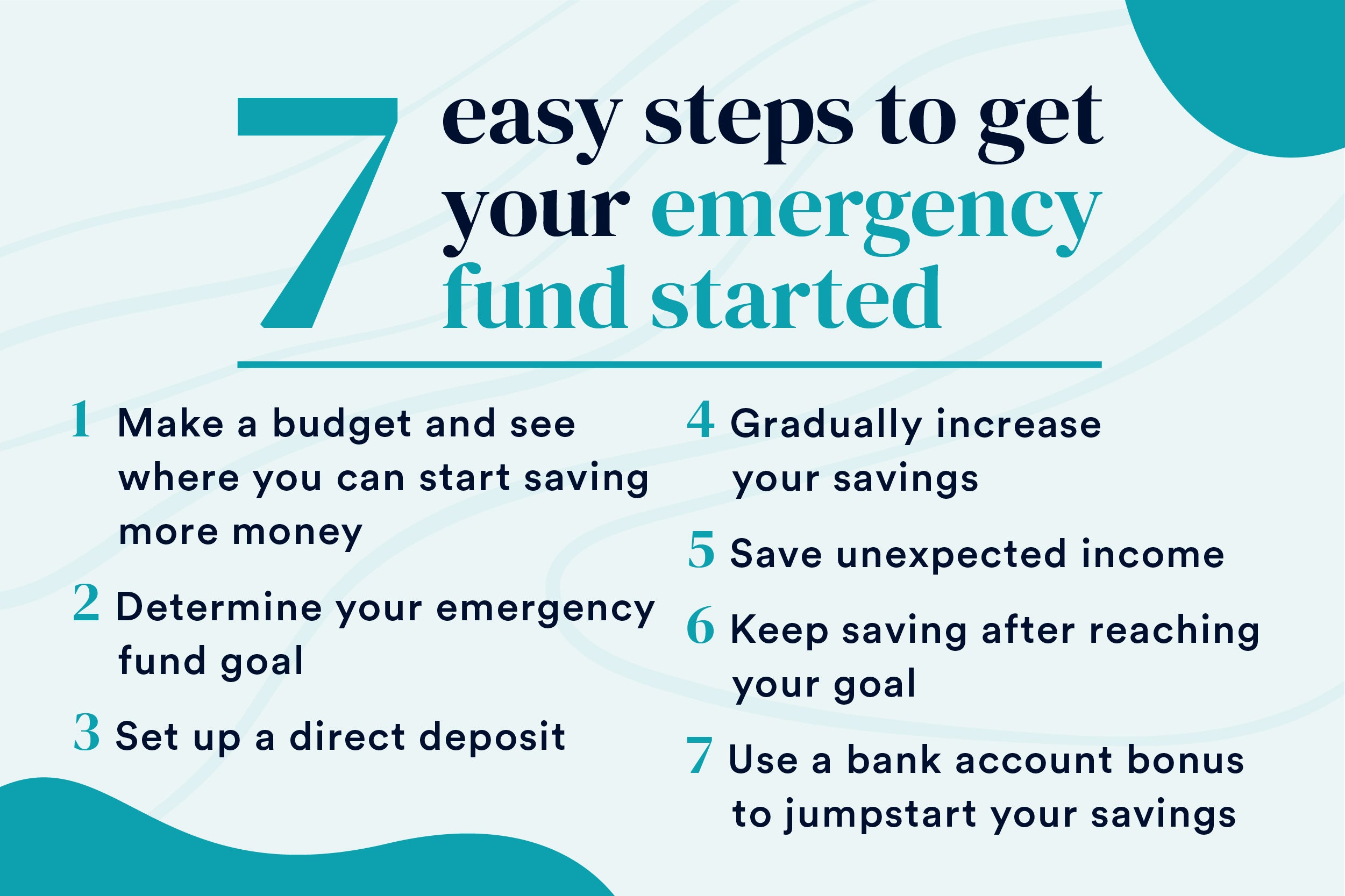
1. Make a price range and see the place you can begin saving more cash
Budgeting is a time-tested methodology for retaining observe of your funds and curbing spending. In actual fact, 13 p.c of these surveyed in Bankrate’s emergency financial savings report stated that budgeting higher is their most important monetary aim for 2024.
To search out methods to save lots of, you first have to grasp the place and the way you spend. Budgeting helps you distribute your earnings extra effectively and discover methods to scale back or handle your spending. Bankrate’s House Price range Calculator may help you to set a price range.
A budgeting app is one other useful gizmo that may make it easier to calculate earnings and bills to supply a dashboard view of your monetary state of affairs.
2. Decide your emergency fund aim
The common family spends $3,828 month-to-month on the requirements of housing, transportation and meals, in line with a 2022 survey by the U.S. Bureau of Labor Statistics (BLS). Calculating what your family wants for such requirements is vital in figuring out your emergency fund aim.
A price range is a spending plan that lets you decide how a lot cash you want every month to cowl important bills. This quantity will be calculated by including up month-to-month prices for housing, meals, transportation and different requirements after which multiplying the sum by six, which provides you the quantity you’ll want to cowl six months of bills. It’s going to take most households a while to achieve the six-month aim.
3. Arrange a direct deposit
About 95 p.c of People indicated they had been paid by means of direct deposit in a 2023 American Payroll Affiliation survey.
Direct deposit mechanically deposits your paycheck and different funds instantly into your checking or financial savings account, eliminating the necessity to manually deposit checks. However all of your funds needn’t go into only one account. Establishing a cut up direct deposit lets you direct a particular amount of cash to your emergency fund with the rest going to your checking account or vice versa. There are additionally financial savings apps that may mechanically switch a share of your paycheck right into a financial savings account.
Automating the method not solely simplifies saving, it may possibly additionally assist hold you on observe towards your financial savings targets.
4. Steadily improve your financial savings
In response to the Bureau of Financial Evaluation, the U.S. private saving charge was 3.7 p.c in December 2023. Private saving charge is the share saved out of 1’s disposable earnings.
A technique you possibly can enhance your financial savings charge over time is to extend the quantity you’re contributing to your emergency fund by 1 p.c or a particular sum, till you’ve reached your financial savings aim. Growing the quantity in increments may help to make the smaller deposit into your checking account seem much less noticeable.
“One of the best ways to construct up emergency fund financial savings when money circulate is tight is to take tiny steps that add up over time,” says Noah Damsky, CFA, Principal at Marina Wealth Advisors. “If you wish to save $150 per 30 days, save $5 per day. Not solely is it much less daunting, however it helps you understand how one can attain your targets by making small sacrifices,” he provides.
5. Save surprising earnings
A monetary windfall consists of coming into a big amount of cash, unexpectedly. Of those that obtain such a windfall, 70 p.c received’t have any of the cash left after a number of years, in line with the American Institute of Licensed Public Accountants.
No less than part of any windfall that you just obtain ought to be used so as to add to an emergency fund, except you have already got a enough one established. Sudden cash can come within the type of a tax refund, bonus, money present, inheritance, or successful a contest or the lottery.
6. Hold saving after reaching your aim
The common value of dwelling for one 12 months is $72,967, in line with the BLS as of 2022. The extra you possibly can add to your emergency financial savings, the longer you’ll have the ability to keep afloat if you find yourself out of labor as a consequence of a job loss or sickness.
Some emergencies require greater than a six-month cushion. Being unemployed for greater than a 12 months or being hospitalized for a number of months are each conditions the place you’ll be glad you may have more cash saved in your emergency fund.
7. Use a checking account bonus to jumpstart your financial savings
Banks steadily provide money incentives to new prospects for opening new checking or financial savings accounts. The extra money will be helpful in establishing an emergency fund or including to an current one. Presently, banks are providing as much as $3,000 in bonuses for opening a brand new checking or financial savings account, or to those that refer a pal or member of the family.
Along with in search of a checking account bonus, one other approach you possibly can improve your checking account steadiness is by ensuring you’re getting the perfect return in your cash. The most effective charges can usually be discovered at on-line banks, which don’t have the overhead prices of sustaining branches.
Conserving your financial savings organized may help hold you on observe to fulfill your monetary targets. Contemplate housing your emergency fund in a separate account than a trip fund, as an example. This will likely assist forestall you from tapping into emergency financial savings for different functions. Some financial institution accounts permit you to allocate parts of your cash into completely different buckets.
Backside line
Having an emergency fund is essential for monetary stability and peace of thoughts. It could assist cowl surprising bills and stop the necessity for high-interest bank cards or loans.
Purpose to save lots of three to 6 months’ price of dwelling bills and contemplate automating your financial savings by means of direct deposit or financial savings apps. Begin small and make it a precedence to construct your emergency fund, as it may possibly make all of the distinction in instances of economic uncertainty.
Emergency fund FAQs
— Bankrate’s René Bennett and Matthew Goldberg additionally contributed to this story.