Bitcoin’s first problem adjustment of 2026 was something however dramatic. The community nudged the dial all the way down to about 146.4 trillion, a fairly small retreat after the late-2025 grind increased.
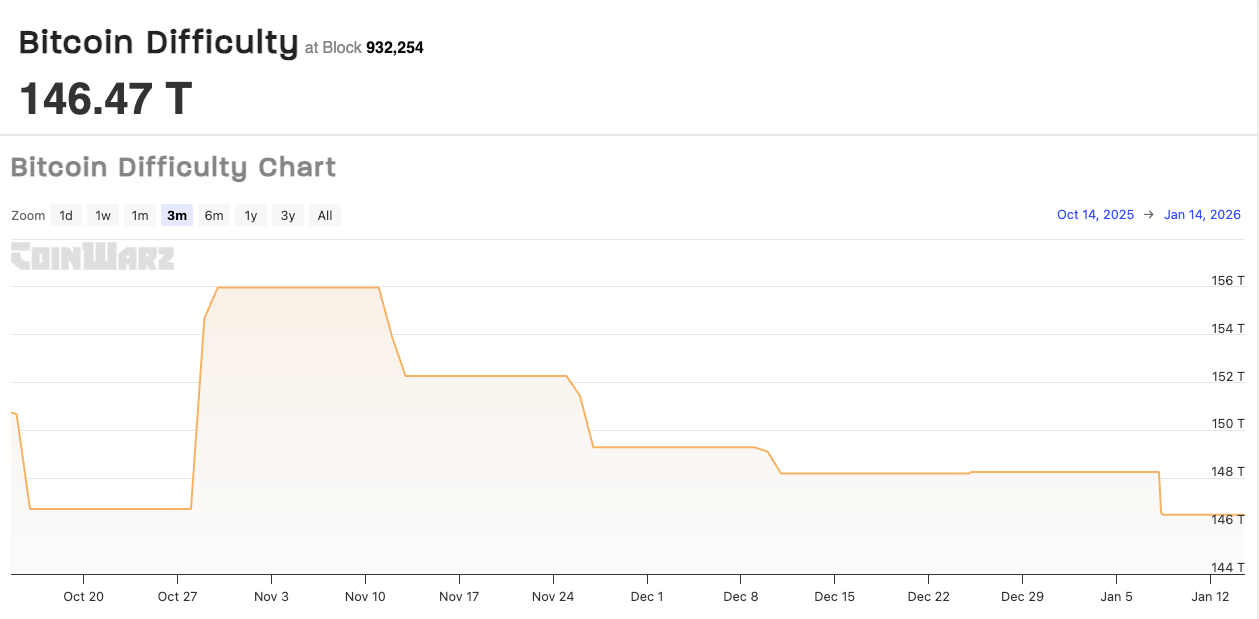
However small is not the identical as meaningless in mining, a enterprise the place margins are measured in fractions of a fraction and the principle enter (electrical energy) can flip from discount to backbreaker in per week. Problem is Bitcoin’s built-in metronome: each two weeks or so, the protocol recalibrates how onerous it’s to discover a block in order that blocks hold arriving roughly each ten minutes.
When problem falls, it normally means the community observed one thing miners really feel earlier than traders do: some machines stopped hashing, at the very least briefly, as a result of economics or operations demanded it.
That issues as a result of in 2026, miners are navigating a squeeze with two layers. There’s the acquainted post-halving actuality of much less new Bitcoin per block, and extra competitors for it. After which there’s the brand new backdrop: a tightening marketplace for megawatts as AI information facilities scale up and begin bidding for a similar energy entry miners as soon as handled as a aggressive moat.
CryptoSlate’s personal reporting has framed this as an vitality conflict the place AI’s always-on demand and political momentum collide with miners’ flexible-load pitch.
To know what the 146.4T print actually means, we’ve got to translate the mining dashboard into plain English, after which join it to the components of the story Wall Avenue typically misses.
Problem is the stress gauge, not the scoreboard
Problem is usually mistaken for a proxy for value, sentiment, and even safety in a broad sense. It’s definitely associated to these issues, however mechanically it’s a lot easier. Bitcoin seems to be at how lengthy the final 2,016 blocks took to mine: if blocks got here in sooner than ten minutes, it raises problem; if blocks got here in slower, it lowers problem.
So why does it learn like a stress gauge if it is that easy? As a result of hashpower is not some type of theoretical amount, it’s actually industrial tools drawing electrical energy at scale. If sufficient miners unplug, blocks decelerate, and the protocol responds by making the puzzle simpler so the remaining miners can hold tempo.
In early January, a number of trackers confirmed common block occasions drifting just below the ten-minute goal (round 9.88 minutes in a single broadly cited snapshot), which is why projections pointed to the subsequent adjustment swinging again upward if hashpower returned.
CoinWarz’s public dashboard, for instance, has displayed the present problem round 146.47T alongside ahead estimates for the subsequent adjustment date.
The essential takeaway is what problem doesn’t say, which is why miners dropped off. It doesn’t inform you whether or not it was a one-day curtailment throughout an influence spike, a wave of bankruptcies, a flood, a firmware situation, or a deliberate technique shift. Problem is simply the protocol’s symptom readout. The prognosis lives elsewhere.
That’s why miners and critical traders pair problem with a second metric, one which behaves way more like an revenue assertion than a thermostat: hashprice.
Hashprice is the miner P&L in a single quantity
Hashprice is mining’s shorthand for anticipated income per unit of hashpower per day. Luxor popularized the time period, and its Hashrate Index defines hashprice because the anticipated worth of 1 TH/s per day.
It is a neat little method to compress block rewards, charges, problem, and value right into a single quantity that exhibits the place the cash is.
For miners, that is the heartbeat that retains them alive. Problem can fall and nonetheless go away miners hurting if the value is weak, charges are skinny, or the worldwide fleet stays intensely aggressive. Conversely, problem can rise whereas miners print cash if BTC rallies or charges spike. Hashprice is the place these variables meet.
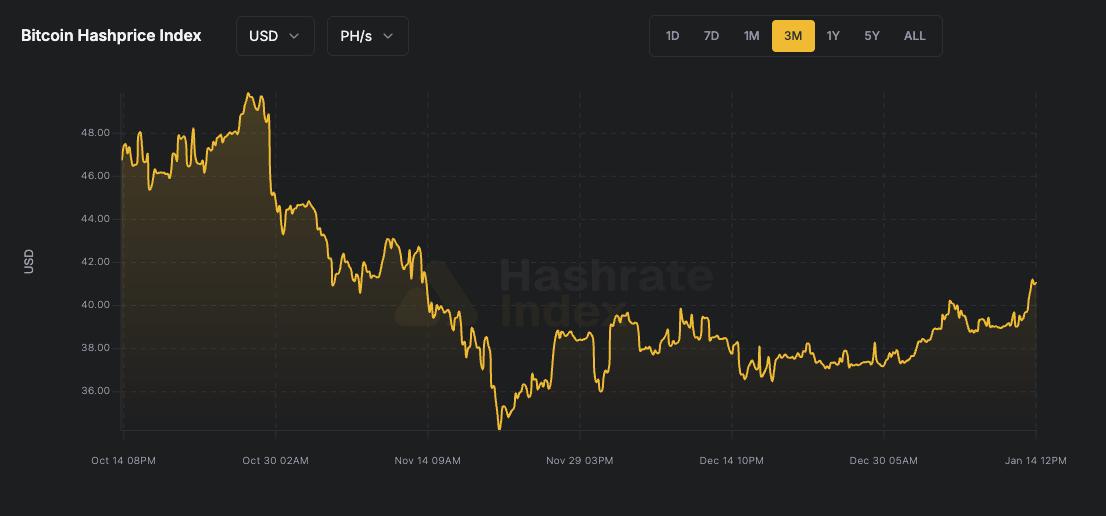
Early-January commentary from Hashrate Index famous that ahead markets had been pricing a median hashprice round $38 (and roughly 0.00041 BTC) over the subsequent six months. That is helpful context as a result of it indicators what subtle contributors anticipate profitability to seem like, not simply what it’s right now.
For those who’re attempting to interpret a modest problem dip like 146.4T, hashprice helps you keep away from a standard mistake, which is assuming that the community threw miners a bone. The community doesn’t know miners exist; it solely corrects timing.
A problem drop is reduction solely within the slender sense that every surviving unit of hashpower has barely higher odds. Whether or not that interprets into actual respiration room will depend on energy prices and financing, variables which have turn out to be a lot much less forgiving.
Right here’s the place consolidation enters the story. As a result of when mining is flush, nearly anybody with low cost energy and entry to machines can survive. When hashprice compresses, survival turns into a operate of steadiness sheets, scale, and contracts.
The consolidation wave is the true problem adjustment
Bitcoin mining is usually described as decentralized, however the industrial layer is brutally Darwinian. When profitability tightens, weak operators don’t simply earn much less; they lose their means to refinance machines, service debt, and safe energy at aggressive charges.
That’s when consolidation accelerates: via bankruptcies, distressed asset gross sales, and takeovers of websites with worthwhile grid entry.
That is the place the mining narrative diverges from the market narrative. Within the ETF-and-macro period, BTC trades like a threat asset with catalysts and flows. Miners, in distinction, dwell in a world of vitality spreads, capex cycles, and operational leverage.
When their world will get tight, they make selections that ripple outward: promoting extra BTC to fund opex, hedging manufacturing extra aggressively, renegotiating internet hosting offers, or shutting down older rigs sooner than deliberate.
A problem dip may be one of many first on-chain hints that this course of is underway. Not as a result of miners are capitulating in a dramatic, one-day occasion, however as a result of sufficient marginal machines quietly go darkish to maneuver the common. The market may see a small quantity, however the business sees a aggressive shakeout starting on the edges.
And in 2026, these edges are being pushed by one thing larger than a single hashprice print, and that is the rising worth of energy itself.
AI is altering the unit economics miners used to take without any consideration
Mining has all the time been an vitality enterprise disguised as a crypto enterprise. The pitch has been easy: discover low cost, interruptible energy; deploy machines shortly, swap off when costs spike, and arbitrage the volatility of electrical energy into a gradual stream of hashpower.
CryptoSlate’s January reporting made the argument that AI information facilities are difficult that mannequin at its basis, as a result of they need certainty, not curtailment, and so they include a political story (jobs, competitiveness, “essential infrastructure”) that miners typically lack.
The identical piece highlighted BlackRock’s warning that AI-driven information facilities might eat an unlimited share of US electrical energy by 2030, turning grid entry into the scarce asset traders are underpricing.
Even should you deal with the high-end forecasts as nothing greater than provocative headlines, the route right here issues: extra baseline demand, extra interconnection bottlenecks, extra competitors for the perfect websites. In that world, miners’ outdated benefits (mobility and pace) can flip into disadvantages if the gating issue is securing transmission upgrades, transformer capability, and long-term contracts.
CryptoSlate’s November characteristic pushed this one step additional: AI isn’t simply competing for energy, it’s competing for capital and a spotlight, pulling liquidity towards compute infrastructure and nudging miners to pivot from hashing to internet hosting.
That piece described miners repositioning themselves as data-center operators and “energy platforms,” exactly as a result of megawatts have gotten extra worthwhile than machines.
None of that is an summary narrative. It is actual information and actual results that change the way you learn problem.
A miner curbing for an hour throughout a value spike is one factor. A miner mothballing a website as a result of an AI tenant pays extra per megawatt over a multi-year contract is one other.
Within the first state of affairs, hashpower comes again when circumstances normalize. Within the second, hashpower could not return in any respect, not as a result of Bitcoin is “dying,” however as a result of the highest-value use of that energy has modified.
That’s the delicate stress embedded in a 146.4T print. The community will hold adjusting, as a result of that’s what it does. The query is what the mining business seems to be like after repeated changes in an atmosphere the place vitality is repriced by AI.
For traders and critical market observers, the sensible worth is in studying the mining tape like a set of linked indicators somewhat than remoted metrics.
Problem exhibits whether or not hashpower is steadily increasing or briefly blinking out as marginal machines shut off, whereas hashprice interprets that very same atmosphere into the one factor miners can’t negotiate with: whether or not the fleet is incomes sufficient to maintain working.
From there, the business’s response tells its personal story, as a result of tightening economics are likely to speed up consolidation, figuring out who will get to maintain enjoying and whether or not the community’s industrial base is changing into extra concentrated.
And behind all of it sits the brand new constraint: vitality competitors, which can resolve whether or not “low cost energy” stays a sturdy moat for miners or a vanishing edge as AI information facilities lock up long-term capability.
Bitcoin gained’t cease producing blocks as a result of problem moved a number of factors, however mining can nonetheless slip right into a regime shift whereas the protocol retains buzzing alongside, quiet and detached.
If 2025 was the yr the sector realized to dwell with the halving’s leaner baseline, 2026 stands out as the yr miners study their actual competitor isn’t one other pool, it’s the information middle down the highway that by no means needs to energy down.