Picture supply: Getty Photos
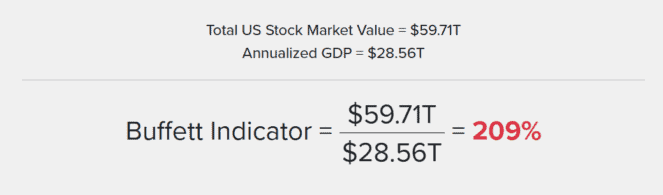
Named after billionaire investor Warren Buffett, the ‘Buffett Indicator’ is a market valuation metric that divides the whole market-cap of US shares by the nation’s GDP. Usually seen as among the finest single market valuation indicators, the metric historically flashes warning indicators when it surpasses 100%.
Not too long ago, it’s climbed to a staggering 209%. This determine is effectively above the historic common, indicating that shares are extremely overvalued relative to the economic system.
The present degree has spurred hypothesis that the inventory market is coming into bubble territory. When valuations are this excessive, it typically alerts future downturns because the hole between inventory costs and financial fundamentals grows.
The final time the Buffett Indicator reached such highs was within the lead as much as the dot-com crash in 2000 and, extra just lately, earlier than the pandemic-driven downturn in 2020.
Including to this, Buffett’s Berkshire Hathaway fund has just lately offered giant parts of its portfolio. The corporate reportedly holds $325bn in money — an unusually excessive quantity even by its requirements. This transfer suggests it could be getting ready for a possible correction, as Buffett has famously suggested towards overvalued markets.
The choice to promote somewhat than purchase displays his cautious strategy, notably given ongoing considerations about excessive rates of interest and unsure financial development.
What to do in a market downturn
For particular person traders, the temptation may be to comply with Buffett’s lead by trimming overvalued shares or reallocating to much less dangerous property. Whereas a market crash is rarely sure, excessive valuations are a great time to judge a portfolio.
Holding some money or diversifying into defensive sectors might present stability if a downturn hits in 2025. Being attentive to valuation alerts and getting ready for elevated volatility is a prudent strategy amid present market dynamics.
For UK traders, a number of defensive FTSE shares have traditionally proven resilience throughout financial downturns. One in every of my favourites is knowledge analytics agency RELX (LSE: REL).
As a world supplier of information-based analytics, it has a robust foothold in authorized, scientific and danger markets. It has a diversified income stream and a recurring subscription-based mannequin, so it’s typically seen as a secure, cash-generative firm.
Over the previous 30 years the share value has elevated at a median charge of seven.36% a 12 months.
Execs and cons
It could be defensive, however RELX nonetheless faces dangers tied to financial cycles and regulatory adjustments. A slowdown in authorized or monetary companies might affect its enterprise segments.
A current concentrate on synthetic intelligence (AI) and analytics has strengthened its aggressive edge, enhancing its digital provide and knowledge companies. However competitors can also be intensifying as digital and AI-driven analytics develop into commonplace within the business.
Latest inventory efficiency has been constructive however macroeconomic challenges, like inflation and rate of interest hikes, might weigh on future development.
Sturdy development means it now has a comparatively excessive valuation with a price-to-earnings (P/E) ratio of 36. This makes it vulnerable to a pullback if development slows. Nonetheless, its revenue margin is nice at round 20% and it has a excessive return on fairness (ROE) of 56%, indicating environment friendly capital utilization.
Though it has a low yield of only one.64%, dividends are dependable and reveal a dedication to shareholder returns. In risky instances, I feel it’s price contemplating as a inventory that might add stability to a portfolio.