In mid-January, an enormous winter storm swept throughout the US, dropping temperatures in Central Texas into the low 20s and inflicting Texans to huddle indoors with their heaters operating full blast. The Texas energy grid creaks and groans when it’s put to the check throughout excessive climate occasions and typically it goes down leaving residents out within the chilly. Nonetheless this time the facility stayed on and it was largely as a consequence of an surprising latest phenomenon: Bitcoin Mining. Bitcoin miners turned their operations off to redirect energy again to important infrastructure & cut back stress on the Texas grid. (Lee Bratcher, President of the Texas Blockchain Council, not too long ago wrote about how there may be appreciable proof that miners in different ISOs equally curtailed their operations, and benefitted grids throughout the nation all through the storm.)
In the meantime, throughout the nation in DC, the Administrator of the Power Data Administration (EIA) was drafting a memo to the Workplace of Administration and Finances calling for an emergency evaluate of cryptocurrency mining operations out of concern for “confused electrical energy techniques” and “heightened uncertainty in electrical energy markets”. Now, the EIA is conducting an emergency information assortment of mining operations and the Bitcoin mining trade is scrambling to reply.
The irony that the EIA launches the emergency information assortment primarily based upon grounds of grid instability on the very second mining empirically demonstrates grid synergy will not be misplaced upon us. Let’s dive into the context for this information assortment, the trade response, and our ideas on the general state of affairs because it stands.
EIA & Emergency Order Context
The EIA “collects, analyzes, and disseminates impartial and neutral vitality info to advertise sound policymaking, environment friendly markets, and public understanding of vitality and its interplay with the economic system and the surroundings.” If a federal company needs to gather info from the general public, they need to ask the Workplace of Administration and Finances (OMB) for permission to make use of taxpayer cash and submit an Data Assortment Request (ICR).
Usually,, the process would appear like this:
- The EIA internally develops the ICR and checks their very own inside approval packing containers.
- The ICR should be printed within the Federal Register for 60 days to place the trade on discover of the proposed survey and afford the general public a chance to remark. (Discover & Remark)
- The EIA evaluations all public feedback, summarizes them in a report, and makes any adjustments to the ICR because of the discover and remark interval.
- The up to date ICR goes again to the Federal Register for one more 30 day discover and remark interval, and is concurrently submitted to the OMB for remaining approval.
- OMB evaluations the ultimate documentation, all feedback, and points their remaining ruling on whether or not the survey will proceed.
Discover and remark is a important facet of the executive legislation course of. For companies such because the EIA, it affords them a chance to contemplate innocuous questions from affected companies similar to: Is amassing this info needed? Do the ends justify the means? How will you ensure that the information the EIA collects is beneficial, top quality, and might be protected adequately?
The EIA has initially chosen 82 operations to ship this survey to, as recognized of their in-depth evaluation printed Feb 1.
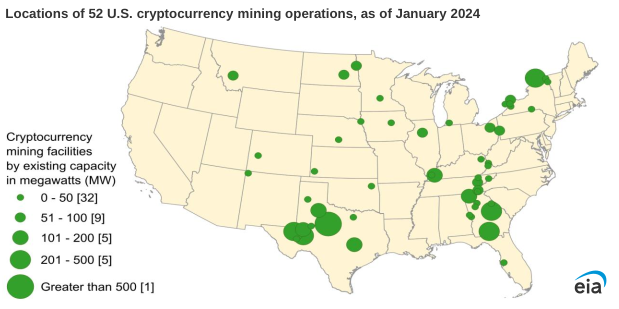
Below regular circumstances, ICRs like this aren’t unprecedented. The EIA has routinely carried out surveys on vitality use for business buildings and producers within the US (one survey on datacenter use had a 26% response charge amongst 50 surveyed), in addition to vitality producers and distributors. It seems the EIA has by no means singled datacenters out for their very own survey past that pilot one, not to mention Bitcoin miners particularly.
Nonetheless, the EIA and the OMB have determined these are not regular circumstances. They’ve triggered the emergency provisions of the Paperwork Discount Act to bypass the discover and remark interval and go straight to the half the place you hand over the entire info pertinent to your mining operations, or else. What is unprecedented is the EIA utilizing these emergency provisions to focus on a particular trade with no discernment over dimension, location, or some other cognizable metric.
There isn’t any 60 day interval. There isn’t any 30 day interval. Survey begins now.
Pushing Again On The Emergency Order
Why ought to we, as an trade, beparticularly important concerning the omission of this seemingly arcane a part of administrative company process?
- The trade is disadvantaged of not less than 90 days to coordinate PR responses, conduct analysis, and plan authorized challenges to the underlying validity of the survey.
- Timelines to develop a compliance plan, converse with attorneys, and coordinate with group members are considerably truncated.
- The trade is given zero alternative to interface with regulators over the kind of info requested, trade issues, or any sensible insights miners might be able to present.
- Discover and remark durations present transparency into the decision-making processes of administrative companies and would enable trade members to ask why these surveys are needed, and affect their course.
Due to this fact, underneath risk of felony penalties and fines of as much as $10,633 per day of noncompliance, miners at the moment are required to report back to the EIA coordinates of services, metrics on electrical energy consumption, id of energy suppliers, quantity and age of ASICs, whole hashrate, and extra.
This all begs the query…what constitutes an “emergency”? In keeping with the statute, companies are permitted to request emergency processing when “public hurt within reason prone to end result if regular clearance procedures (specifically, discover and remark) are adopted.”
By consequence, the stance of the OMB and the EIA is that this: “If the usual 90 day discover and remark interval is noticed, then one thing might occur that’s fairly prone to trigger public hurt. If we circumvent the discover and remark interval and begin amassing information now, then public hurt is much less prone to happen.”
There are two potential takeaways from this:
- The EIA and OMB are actually reaching for emergency justification, as little cheap motion could possibly be taken within the subsequent 90 days that will have any materials impact on miners’ general market demand for electrical energy. There could also be motive to contemplate that utilities use off-peak season for future planning & enlargement, so this emergency order would speed up to account for 2024 on-peak planning.
- There could also be intention to take motion within the subsequent 90 days primarily based on the findings of the survey that will materially have an effect on miners’ general market demand for electrical energy.
(Readers might discover it fascinating that the Bitcoin halving is nearly precisely 90 days from the 1/26 emergency order)
The query stays…what exactlyis the emergency right here? Here’s what we’re given within the official approval of the survey printed by the OMB:
“EIA has decided that… public hurt within reason doubtless if regular clearance procedures are adopted. As proof, the value of Bitcoin has elevated roughly 50% within the final three months, and better costs incentivize extra cryptomining exercise, which in flip will increase electrical energy consumption. On the time of this writing, a lot of the central United States is within the grip of a significant chilly snap that has resulted in excessive electrical energy demand. The mixed results of elevated cryptomining and confused electrical energy techniques create heightened uncertainty in electrical energy markets, which might lead to demand peaks that have an effect on system operations and shopper costs, as occurred in Plattsburgh, New York in 2018. Such circumstances can materialize and dissipate quickly. Given the rising and quickly altering nature of this subject and since we can not quantitatively assess the chance of public hurt, EIA feels a way of urgency to generate credible information that would offer perception into this unfolding subject. “
The Bitcoin mining trade, no strangers to chaotic financial & regulatory environments, has begun responding.
Business Response
The emergency ICR has been dispatched to roughly 82 miners, who presumably account for the majority of the US’ hashrate. Whereas this information will finally be gathered from all business miners, our direct conversations with a number of trade members counsel that consciousness of this ICR won’t but be widespread. Nonetheless, a number of mining advocacy organizations have already issued formal responses.
The Texas Blockchain Council (TBC) has come out strongly in opposition to the emergency ICR:
“The EIA’s necessary emergency survey of electrical energy consumption represents the most recent in a politically-motivated marketing campaign in opposition to Bitcoin mining, cryptocurrency, and US-led innovation. We consider this could trigger concern for all industries that depend on information facilities as a part of their operations”.
The TBC calls this an “abuse of authority” and factors to the abundance of voluntary information transparency already out there for the younger mining trade. It additionally factors to exhibitions of miner’s synergy by providing “important grid-stabilizing advantages” which had been “on full show throughout latest durations of chilly climate in Texas”.
Dennis Porter of the Satoshi Motion Fund says “this isn’t the hill to die on” and that miners ought to lean into clear information reporting as the most efficient response. Porter says “bitcoin miners have to keep away from placing yet one more goal on their again” and to keep away from escalation. Satoshi Motion’s Mandy Gunasekara says “Notably lacking from the EIA letters is any info pertaining to Bitcoin mining’s file of curbing operations at key moments to shore up grids when demand spikes” and encourages miners to take part of their voluntary curtailment survey.
Twitter has produced a variety of responses, together with observations of the particular peculiarities of the survey, similar to geographical coordinates & punitive measures for non-response.
https://x.com/AB_Brammer/standing/1753057141622014025?s=20
Points & Mischaracterizations
EIA Administrator Joseph DeCarolis’s memo to the OMB particularly refers to an occasion 6 years in the past the place the presence of cryptocurrency mining allegedly contributed to antagonistic results on grid pricing, nonetheless we see overwhelming empirical demonstration that mining exercise is inversely proportional to grid vitality costs. That is both a major omission or deliberate mischaracterization.
Moreover, the memo claims miners are modular and “will flock to low price electrical energy, which makes demand projections tough to plan.” Nonetheless, now we have seen little proof that Bitcoin miners are able to such swift mobility at scale. An identical (and viable) criticism of the trade is the comparatively brief lifespan of some operations, leaving unused grid capability after the mining rigs are gone.
One other evident omission is that whereas the EIA might not have totally assessed the state of home Bitcoin mining, regional utilities have carried out these assessments. These utilities work intently with miners and grid operators to undertake refined demand response contingency plans for the very emergency situation used to justify the ICR.
Lastly, the EIA solely cites solely two examples for his or her declare that there’s any precedent for emergency ICRs similar to this. EIA types 878 and 888 had been used with a view to reply to challenges instantly associated to particular occasions of battle or pure catastrophe (Hurricane Sandy in 2012 & the Iraq Conflict in 1991) to observe the provision and affordability of gas reserves.
These emergency ICRs had been focused in response to unfolding catastrophes like battle and pure catastrophe. Right here, now we have a wider survey being carried out in anticipation of an ill-defined, theoretical emergency.
Conclusion
Our pals and colleagues on the Texas Blockchain Council have acknowledged: “Though Bitcoin is resilient and can’t be banned worldwide, the administration is searching for to make the lives of Bitcoin miners, their staff, and their communities too tough to bear working in the US. That is deeply regarding.”
We agree. We discover that each the choice to make the most of the emergency provision and circumvent a dialogue with our trade and the purported rationale for the emergency to be at finest misguided and doubtlessly in dangerous religion.
Bitcoin mining will not be a risk to the American energy grid, public security, or to residential energy prices. Bitcoin mining will deliver funding into our rural communities, assist optimize electrical energy markets, capitalize on wasted assets, and may deliver prosperity to many jurisdictions that embrace this trade. Let’s guarantee America stays professional Bitcoin & professional Bitcoin Mining.
It is a visitor submit by Charlie Spears and Storm Rund, with advisory enter from Micah Burdge and Colin Harper. Opinions expressed are completely their very own and don’t essentially mirror these of BTC Inc or Bitcoin Journal.