Picture supply: Getty Photos
Transfer apart Rolls-Royce and Fresnillo — this small-cap biotech share is skyrocketing previous among the UK’s main progress shares. Up 100% this yr, OXB (LSE: OXB) is taking no prisoners because it fights to get better its losses from 2022.
Between November 2021 and October 2022, the share value crashed 78%, falling from a excessive of £16.78 to nearly £3 per share. The value continued to fall by means of 2023 however has now recovered to £4.18 — the very best it’s been in over a yr.
So what’s subsequent for the inventory?
Slicing-edge biotechnology
Beforehand often known as Oxford Biomedica, OXB is a comparatively small £442m inventory listed on the FTSE All-Share index. The Oxford-based biopharmaceutical firm focuses on cell and gene remedy, specialising in viral vector manufacturing. It has over 25 years of expertise working with among the main pharmaceutical and biotech companies globally.
Not too long ago it shifted to a pure-play contract growth and manufacturing organisation (CDMO), aiming to place itself as a frontrunner in viral vector providers, serving to different companies develop and commercialise gene therapies.
Over the previous yr, its portfolio grew to incorporate 37 shoppers and 48 programmes, specializing in viral vector varieties like lentivirus and adeno-associated virus (AAV). The worth of those contracts is roughly £94m as of 31 August.
Shaky financials
Final yr was not sort to OXB, with the share value falling 50%. Within the first half of 2023, it reported a 33% drop in revenues in comparison with the identical interval in 2022. The decline was primarily because of the non-recurrence of AstraZeneca Covid vaccine manufacturing. It additionally posted an working EBITDA lack of £33.7m, larger than the £5.8m loss within the earlier yr. This was attributed to inflation mixed with larger bills associated to its new Oxford Biomedica Options division.
Issues appear to be enhancing in 2024, though first-half earnings have been nonetheless considerably disappointing. Each income and earnings per share (EPS) missed analyst expectations, by 4.7% and 110%, respectively. Though it posted a internet lack of £32.5m, this was a 32% enchancment on H1 2023.
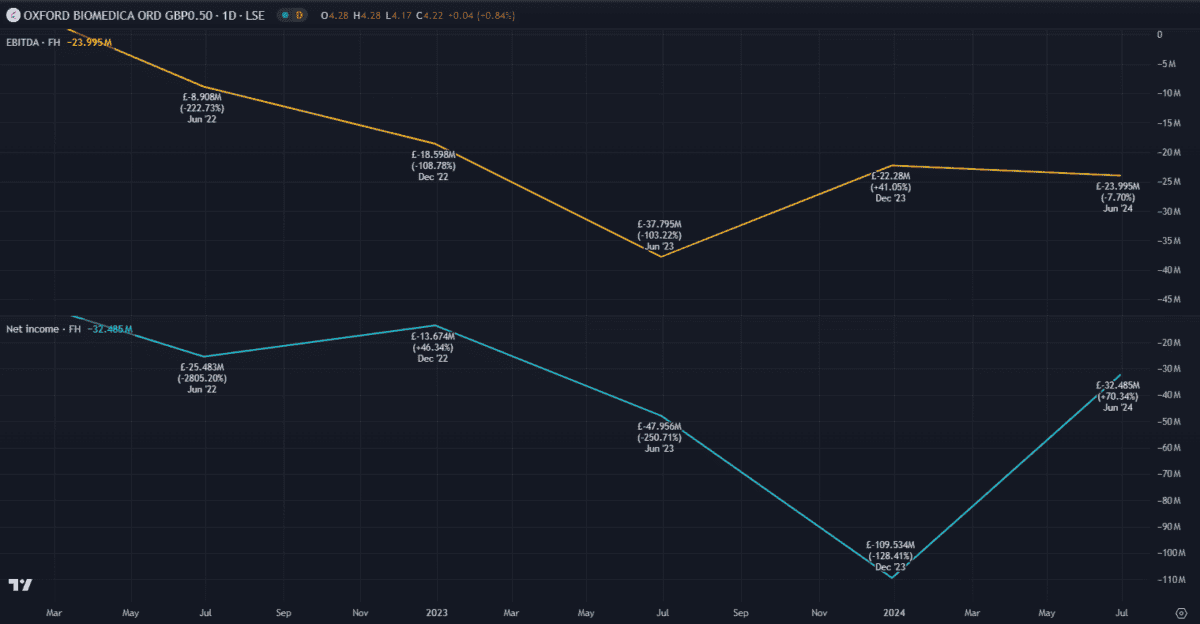
The steadiness sheet appears to be like okay for now, with a debt-to-equity ratio of 55.8%. Nonetheless, it’s burning by means of money and piling on debt, presumably because of elevated operational bills and rising bioprocessing prices.
Money and liquidity are key areas to observe as the corporate expects to interrupt even in EBITDA by the top of 2024. In an announcement made in September through the rebranding to OXB, new CEO Dr. Frank Mathias mentioned it goals to enhance its monetary standing by specializing in its position as a CDMO.
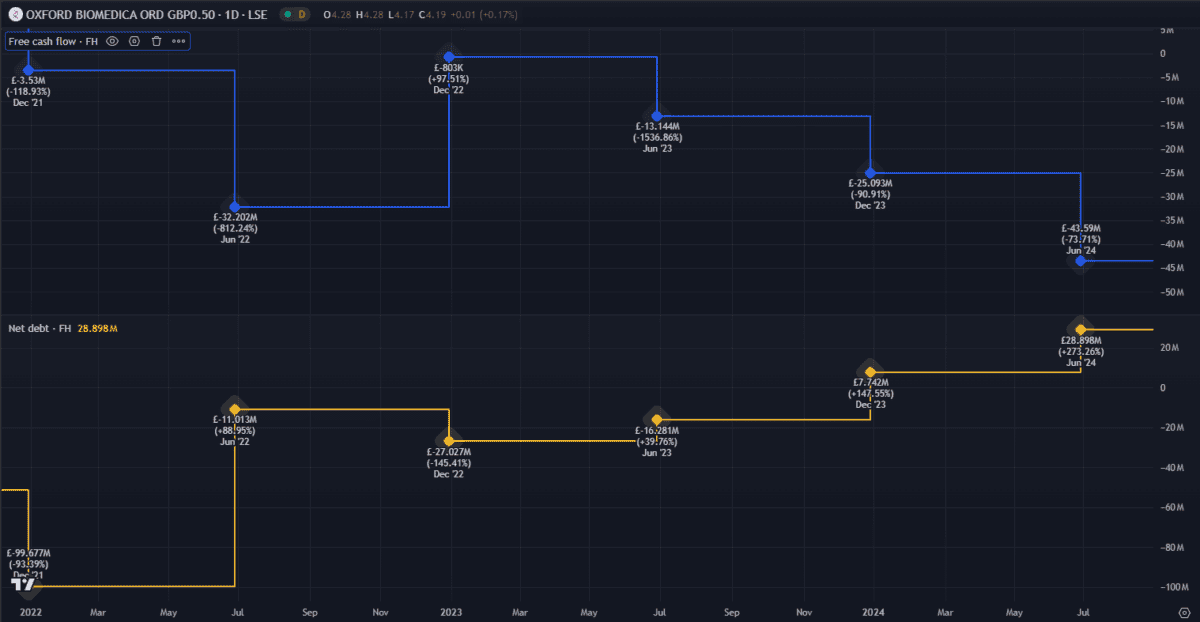
It’s unclear how properly the change to a CDMO will repay, however the value is already reacting positively. Nonetheless, the loss of a big consumer like Novartis may simply flip issues round. It already faces robust competitors within the CDMO market — any drop in efficiency may lead to misplaced contracts.
If issues go properly, the transition ought to present extra secure, long-term income versus the unstable revenues from inner R&D. I count on it’s going to proceed to do properly so if I weren’t already a shareholder, I’d fortunately purchase the inventory at the moment.