Picture supply: Getty Pictures
Based mostly on payouts over the previous 12 months, Harbour Vitality (LSE:HBR) is likely one of the finest dividend shares on the FTSE 250. On account of its beneficiant yield, it sits comfortably inside the prime 10% of shares within the UK’s second tier of listed firms.
And following the acquisition of property beforehand owned by Wintershall Dea, it’s now the biggest oil and gasoline producer within the North Sea. This transformational deal, which was accomplished in September 2024, means the group now has the monetary firepower to additional improve its dividend.
Certainly, the corporate intends to pay $380m to legacy shareholders over the following 12 months. At present (9 January) change charges, this equates to 21.5p (26.4 cents) a share. On the time of writing, Harbour Vitality’s shares are altering palms for round 265p. This means a yield of 8.1%, greater than twice the FTSE 250 common.
However returns to shareholders are by no means assured, notably within the oil and gasoline sector. Earnings could be unstable, which suggests dividends can fluctuate considerably from one interval to a different.
Nevertheless, in it’s quick existence as a listed firm, Harbour has a powerful document of steadily rising its payout (see desk beneath).
| Monetary 12 months | Dividend kind | Dividend per share ($) |
|---|---|---|
| 2021 | Ultimate | 0.11 |
| 2022 | Interim | 0.11 |
| 2022 | Ultimate | 0.12 |
| 2023 | Interim | 0.12 |
| 2023 | Ultimate | 0.13 |
| 2024 | Interim | 0.13 |
Extra earnings
Undoubtedly, this has been made attainable by spikes in wholesale oil and gasoline costs, notably in 2021 and 2022.
However this can be a double-edged sword.
In response to public strain, the earlier authorities launched a ‘windfall tax’, formally often called the Vitality Income Levy (EPL). Not surprisingly, the corporate’s share value has been steadily declining for the reason that Could 2022 announcement.
Subsequent will increase imply the group now faces an efficient company tax charge of 78% on its earnings derived from the UK Continental Shelf.
Partly, this explains the acquisition of Wintershall Dea’s oil and gasoline fields. None of those are in UK waters, subsequently the EPL doesn’t apply. And on account of the deal, the group is now producing 90% greater than beforehand. This provides me some confidence that it will probably proceed to develop its dividend.
Commodity costs
Present laws means the EPL will stay till 31 March 2030. However there are provisions for it to be scrapped.
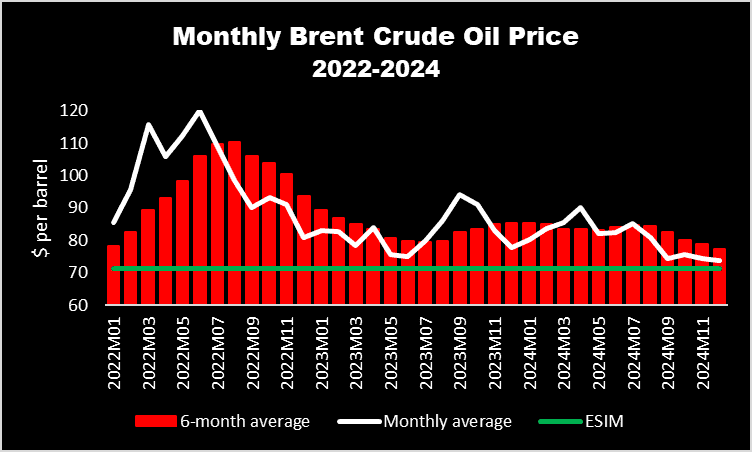
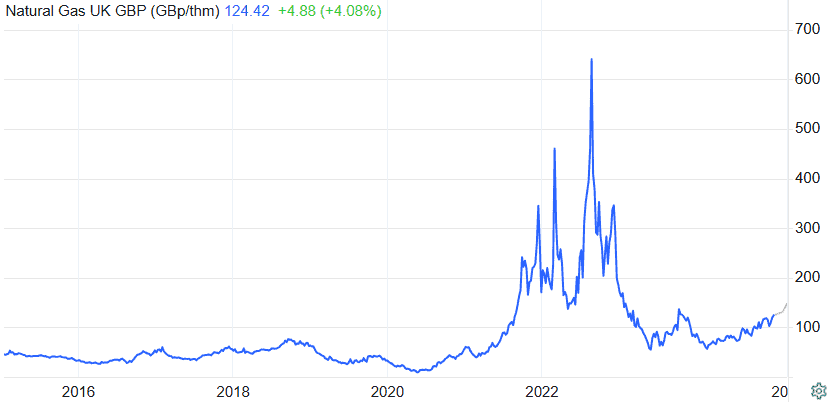
On the one hand, a falling oil and gasoline value would harm income. Nevertheless, if (for six consecutive months) the typical month-to-month oil value falls beneath $71.40 — and the gasoline value goes underneath 54p a therm — the ‘windfall tax’ can be abolished.
However this seems unlikely to occur any time quickly.
Though Brent crude is falling, it nonetheless stays above the value ground.
And I ponder if gasoline costs will ever drop beneath 54p once more.
In my view, it seems as if the EPL is right here to remain.
My opinion
Regardless of this, I plan to maintain my Harbour Vitality shares.
That’s as a result of I believe diversifying away from the UK is an efficient transfer.
And though it’s unimaginable to precisely predict future power costs, the extra earnings earned outdoors of Britain’s waters ought to assist be sure that the group is ready to — at the least — keep (in money phrases) its beneficiant dividend.